Shipped & live
Running todayOSHA 1910 & 1926 complete, 1904, 1903, the OSH Act, and a decade of interpretation letters (2016–2026) — 7,220 passages. Every answer carries the exact paragraph it came from.
Nothing to install, no IT ticket. Ask questions, draft JHAs and incident reports into clean PDFs, check a written program for what's missing.
Canary keeps what it makes. Every answer, draft, and determination saves itself with its citations — searchable, re-exportable, and waiting when you come back. Work belongs to your company, not one login.
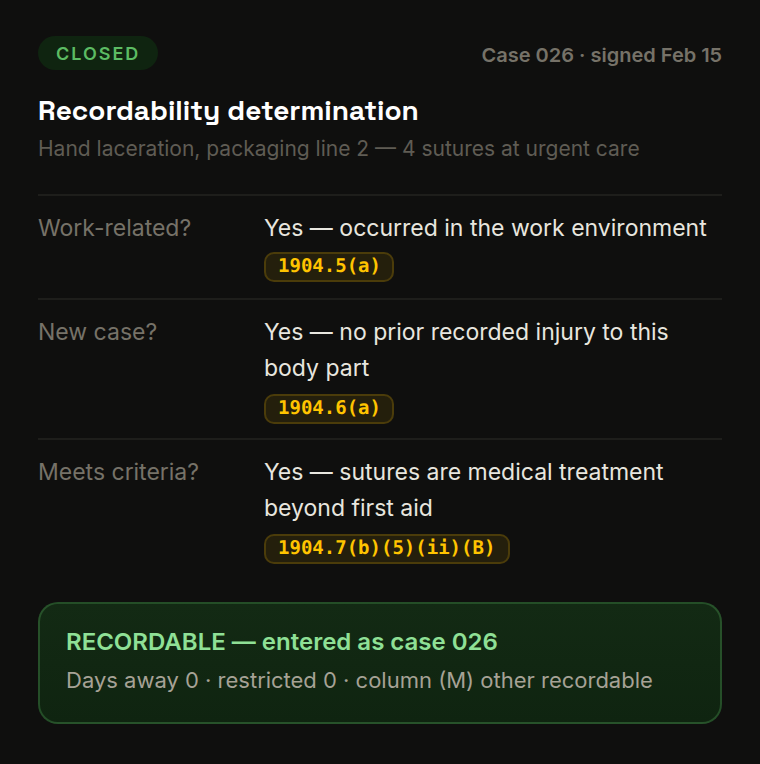
Five plain questions about an incident → a formal determination memo: the 1904 criteria walked in order, the official letters that back the call, exported for your OSHA 300 log file. See how OSHA actually rules these in the Answer Library.
Three free questions against the real engine, right on the homepage — no signup, no email. Go ask it something.
107 questions answered from official letters — free, cited, public, and growing whenever an interesting one turns up.
Per-user limits, hardened security, and a 246-check retrieval suite every build must pass before it ships. Miss one, nothing ships.
In the workshop
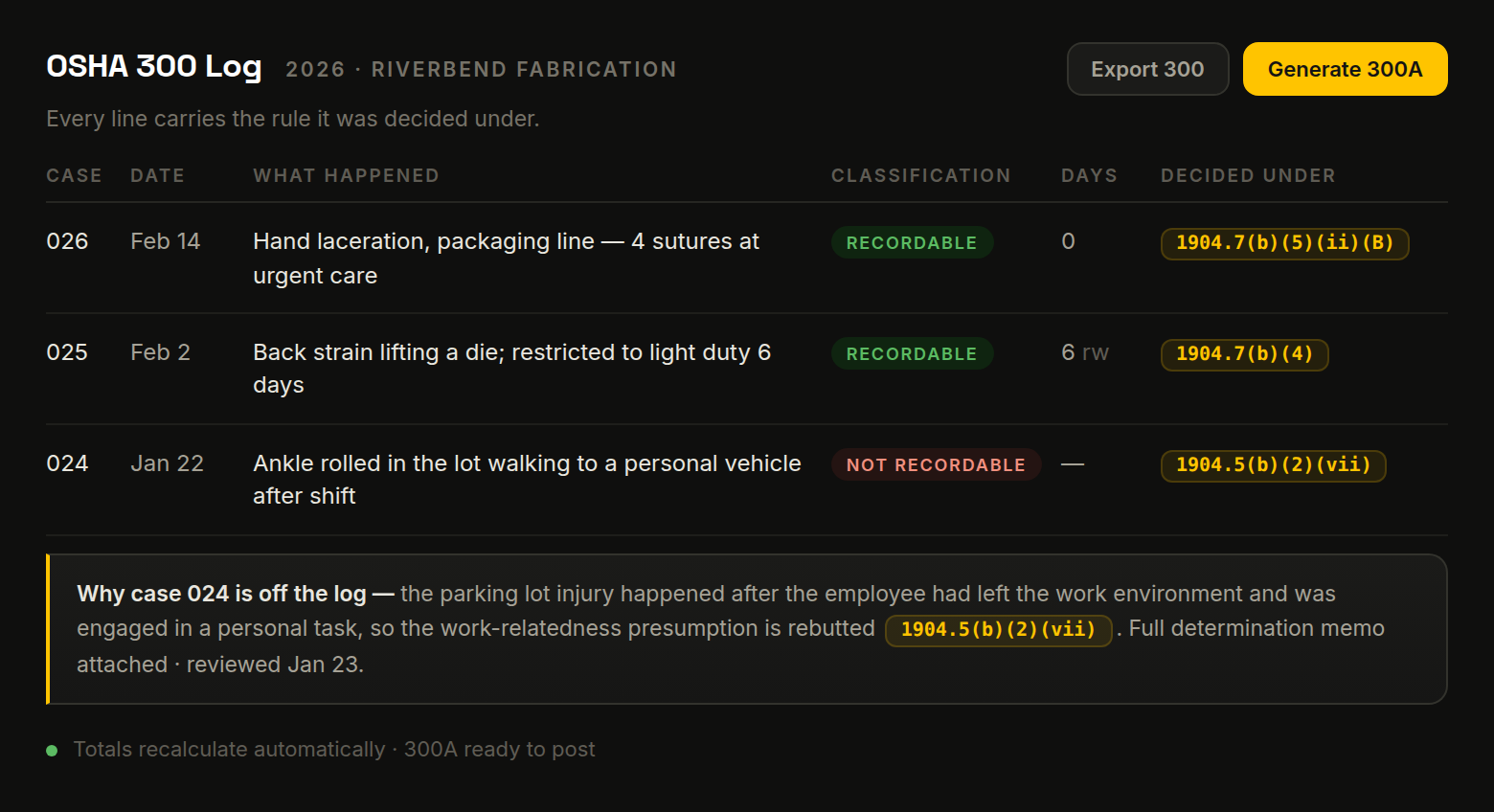
Being built nowIncidents go in through the five-question determination. The log keeps itself — and every line carries the rule it was decided under. The 300A generates from it, totaled, ready to post February 1st.
Records get a state: current or superseded, open or closed, due or done. A JHA has one current version. An incident closes. Nothing sits in an undated pile.
Every determination is machine-verified against the passages it cited. If you think a call is wrong, one tap re-runs the reasoning and puts it in front of a human. Getting corrected fast beats never being wrong.
No more picking a category before you've said anything. Ask however you'd say it out loud; Canary works out what kind of answer you need and tells you what it chose. Follow-up questions remember the conversation.
Next
After the log · not startedWhoever got handed safety usually got handed the stormwater permit too. Hazardous waste generator status, SPCC, stormwater, Tier II and TRI — the federal rules and EPA's own guidance, cited the same way. The start of a permanent environmental library.
Your written program, a spreadsheet of injuries, a photo of a scaffold — put it in and ask about it. Your documents answered in their own labeled lane, never mixed up with what the law says.
For the director covering four sites with nobody at any of them: invite your site leads into the same workspace, same records, one account.
The incident report form, training records with expiry dates, and the deadlines that come with them — surfaced before they bite, not after.
Further out
Ideas · no date · may never happenSome companies will never let a document off their own hardware, and that's a reasonable position to hold. Running the whole thing locally is possible and currently about fifteen times slower and forty times more expensive, so it's parked behind a written trigger rather than a date. A small local model already does the embeddings today — that's the job local hardware is actually good at.
The corpus is a snapshot that gets rebuilt on purpose, not a live mirror of the eCFR. Every answer says so, which is honest and is still homework handed back to you. Tracking amendments automatically — and flagging the saved determinations a change would affect — is a real project and the most valuable thing on this list.
Roughly two dozen states and territories run their own OSHA-approved programs and several are stricter than the federal floor. Right now Canary knows the federal rule cold and has no idea what your state adds. Michigan first, for reasons that are entirely about where I live.
Today the interpretation letters run 2016 to 2026 — a decade, 279 of them. OSHA has been writing them since the seventies. Going back further means older language, superseded standards, and letters that were themselves later overruled, so it needs a way to mark what's still good law before it's worth anything.
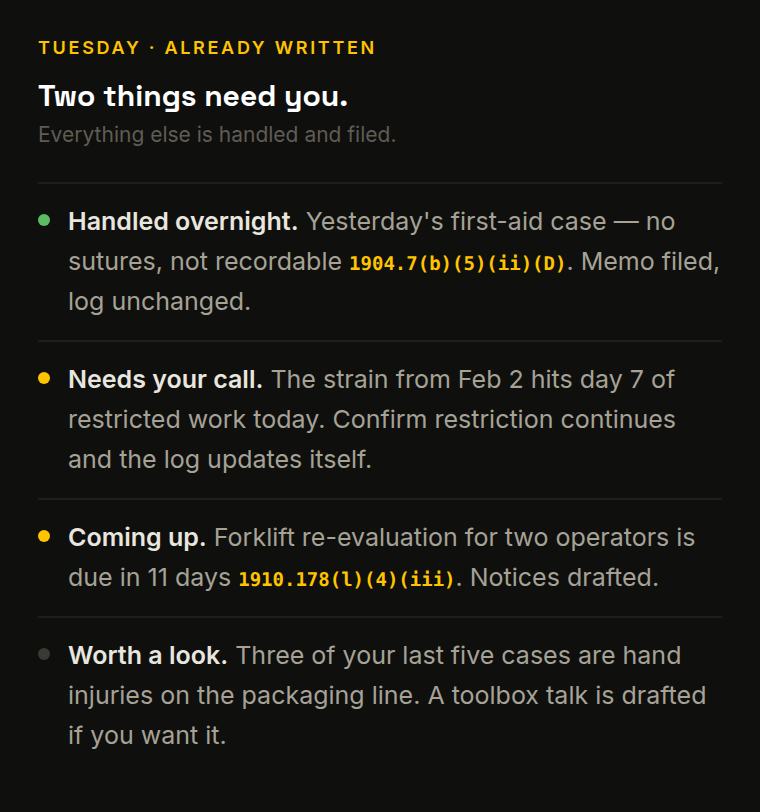
What happened over the weekend, what needs a decision from you, what comes due this week — assembled before you sit down, each line carrying the rule behind it. Trivial to describe, depends entirely on everything above it actually working first.
Every determination it makes is a claim someone might one day have to defend. The interesting version of this project isn't one that's never wrong — it's one where every call is challengeable, every correction is logged, and the reasoning is still there to read years later.
The destination
The safety department for
companies that don't have one.
None of this exists yet. That's why it's the last stop.
Safety software gets built for safety departments. If you're the ops lead, the HR manager, or the only safety person covering three sites, you are not who any of it was designed around — and there are an enormous number of you. The end state is the whole function in one login: the log keeps itself, the paperwork writes itself, and every decision inside it can show the rule it was made under. Whether it ever gets all the way there is an open question. It's the one worth working on.
Free, no signup. The engine on the home page is the real one.